Physical Address
304 North Cardinal St.
Dorchester Center, MA 02124
Physical Address
304 North Cardinal St.
Dorchester Center, MA 02124

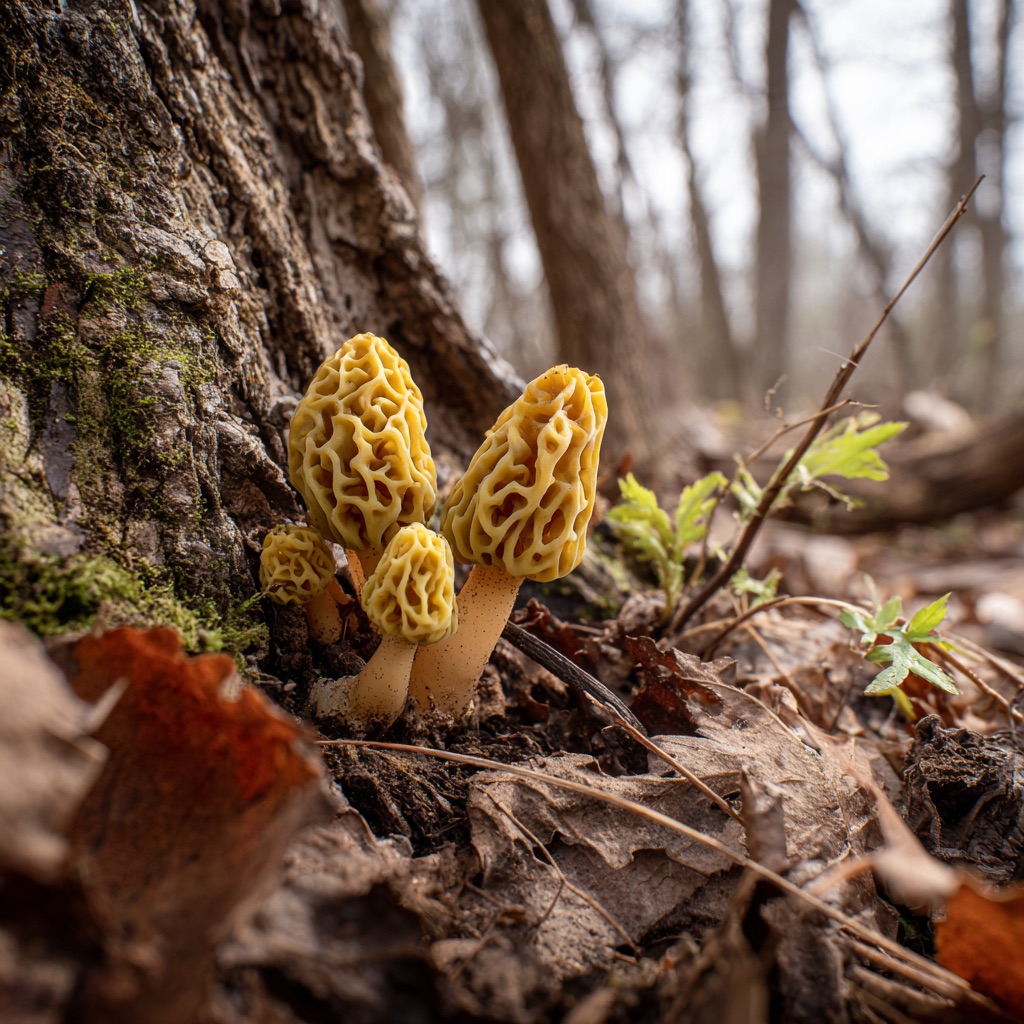
Ask a serious morel hunter where the best hunting in North America is, and a surprising number of them will lower their voice and say somewhere in the Great Lakes region. The sand dunes and mixed forests of Michigan’s Lower Peninsula. The river bottoms of Wisconsin’s Driftless Area. The aspen parklands of Manitoba in a good year. The boreal-edge forests of Ontario where morels and porcini overlap in the same June window.
This is big country. The Great Lakes basin alone encompasses more than 200,000 square miles of forest, wetland, and shoreline. Add the vast boreal and mixed-wood forests of Ontario, Quebec, Manitoba, Saskatchewan, and British Columbia, and you have a mushroom hunting territory so large that most hunters spend their entire lives exploring only a fraction of it — and finding more than they can carry home.
The Great Lakes and Canadian forests reward hunters who understand the land, the species, and above all, the timing. Seasons here are compressed and intense. When the conditions align, the flushes can be spectacular. When they don’t, the forest keeps its secrets. This guide will help you show up at the right time, in the right place, with the right knowledge to make the most of one of North America’s greatest wild mushroom hunting regions.
SPRING (April–June): MORELS
Morel season in the Great Lakes follows a predictable northward and upward progression. Southern Michigan, Wisconsin, and Minnesota see their first flushes in mid-to-late April. The northern shores of Lakes Michigan, Huron, and Superior, along with Ontario’s southern cottage country, peak in May. The Upper Peninsula of Michigan, northern Wisconsin, and the boreal edge of Ontario and Manitoba push into June. In a late-snow year, June morels at the boreal edge can be extraordinary.
LATE SPRING–EARLY SUMMER (June–July): OYSTER MUSHROOMS, CHICKEN OF THE WOODS
As morel season winds down, oyster mushrooms flush on dead hardwoods throughout the region. Chicken of the woods appears on dead and dying oaks and other hardwoods, often producing multiple flushes through the summer.
SUMMER (July–August): CHANTERELLES, LOBSTER MUSHROOMS
Chanterelles begin appearing in the mixed hardwood and hemlock forests of the Great Lakes region in July, peaking in August. In Canada, particularly in Ontario and BC, chanterelles are a major summer and early fall species. Lobster mushrooms appear in the boreal and mixed forests of Ontario and Quebec in late summer.
FALL (September–November): PORCINI, HEN OF THE WOODS, MATSUTAKE, HEDGEHOGS
Fall is the crown of the Canadian mushroom season. King boletes (porcini) erupt in the boreal forests of Ontario, Quebec, and the western provinces after the first cool rains of September. Hen of the woods anchors old oaks across the Great Lakes states. Matsutake appears under jack pine in Ontario and under various pines across BC. Hedgehog mushrooms carpet the forest floor in mixed conifer stands well into October and November.
The Great Lakes states — particularly Michigan — have a near-mythical reputation among morel hunters, and it’s well-earned. Several factors converge to make this region uniquely productive:
SANDY SOILS AND MIXED FORESTS
Michigan’s Lower Peninsula sits on glacially deposited sandy soils that warm quickly in spring and drain well after rain — ideal morel conditions. The mixed forests of aspen, oak, elm, ash, and cherry that cover much of the region provide the diverse hardwood association that morels favor.
THE DYING TREE FACTOR
Dutch elm disease has been working through the Great Lakes forests for decades, and the emerald ash borer has more recently devastated ash populations across the region. The result is an abundance of dying and recently dead hardwoods — prime morel habitat. Hunters who learn to identify dying elms and ashes have a significant advantage.
THE LAKE EFFECT
The Great Lakes moderate temperatures in the surrounding landscape, extending spring and delaying hard frosts in fall. The lake-influenced microclimates along the shores — particularly the western shore of Lake Michigan in the so-called “Fruit Belt” of southwest Michigan — create conditions that produce some of the most reliable and prolific morel flushes in North America.
ASPEN ASSOCIATION IN THE NORTH
In the northern Great Lakes and the Canadian Shield, morels have a strong association with trembling aspen. The expansive aspen forests of northern Michigan, Wisconsin, Minnesota, and Ontario’s boreal edge can produce extraordinary flushes in favorable years. Learn to identify aspen — round, flattened petioles that make the leaves quake in even a light breeze, smooth white-green bark — and you’ll find productive morel habitat across an enormous geographic range.
Canada’s mushroom hunting culture is less developed than in the US in some regions, which means less competition and more pristine hunting grounds. But there are important differences to understand before heading north:
SPECIES OVERLAP AND DIVERGENCE
The Great Lakes states and southern Ontario share many of the same species. As you move north into the boreal forest, the species palette shifts. True morels give way to the burn morel (Morchella tomentosa) in post-fire boreal zones. Chanterelles in Ontario and Quebec are often a mix of species including the eastern chanterelle (Cantharellus enelensis) and the smooth chanterelle. Porcini in the boreal are often Boletus pinophilus (the pine bolete) rather than the classic Boletus edulis. Learn to work with regional field guides.
CROWN LAND ACCESS
Canada’s Crown land system is one of the great underappreciated assets for mushroom hunters. The vast majority of Ontario, Quebec, Manitoba, Saskatchewan, and BC is publicly accessible Crown land where recreational mushroom harvesting is generally permitted. Unlike the US, where public land can be fragmented and access rules complex, much of Canada’s productive mushroom country is simply open — walk in, hunt, walk out. Check provincial regulations for any quantity limits or permit requirements, which vary by province.
PROVINCIAL PARKS
Provincial parks in Canada vary in their foraging policies. Some permit personal-use harvesting; others prohibit it entirely. Always check the specific park’s regulations before collecting. National Parks in Canada (Parks Canada) generally prohibit wild plant and mushroom harvesting.
DISTANCES AND REMOTENESS
Canada’s productive mushroom country is often genuinely remote. The boreal forests of northern Ontario and Quebec are not casual day-trip destinations. Plan accordingly — carry emergency gear, download offline maps, file a trip plan with someone reliable, and be prepared for the reality that cell service may not exist for hours of driving in any direction.
MORELS: MIXED HARDWOODS, DYING ELMS AND ASHES, ASPEN FOREST
In the Great Lakes states, hunt the classic hardwood associations — dying elms and ashes, south-facing slopes early in the season, river bottom timber, and old orchards. In Michigan’s Lower Peninsula, the sandy-soiled mixed forests between the lake shore and the interior are exceptionally productive. In the northern Great Lakes and Ontario, shift focus to aspen-dominated forest and the edges of mixed aspen-birch stands.
CHANTERELLES: HEMLOCK AND MIXED HARDWOOD FOREST
Great Lakes chanterelles tend to favor hemlock-hardwood forest — the classic northern Michigan and Wisconsin forest type of hemlock, yellow birch, sugar maple, and beech. Look for them on well-drained slopes and ridges in mature forest with a thick duff layer. In Ontario and Quebec, chanterelles fruit in mixed hardwood and boreal-edge forests under yellow birch, beech, and balsam fir.
PORCINI / KING BOLETE: BOREAL AND MIXED CONIFER FOREST
The boreal forests of Ontario, Quebec, and the western provinces are exceptional porcini territory. Look for king boletes under spruce, fir, and pine after the first significant rain of September. The jack pine and black spruce forests of the Canadian Shield can produce extraordinary porcini flushes in a good year. Fruit from the same general areas annually — porcini are strongly site-faithful.
HEN OF THE WOODS: OAK FORESTS OF THE GREAT LAKES STATES
Hen of the woods is primarily a Great Lakes states species in this region — the oak-dominated forests of Michigan, Wisconsin, Minnesota, and Ohio produce reliably. Look at the base of large, old white oaks and bur oaks in September and October. In Ontario, hen of the woods is less common but present in the oak savannas of southern Ontario.
MATSUTAKE: JACK PINE IN ONTARIO AND MIXED PINE IN BC
Ontario’s jack pine forests on the Canadian Shield produce matsutake (Tricholoma murrillianum group) in fall, often in areas that look almost too sparse and sandy to be productive. In BC, matsutake fruits under a variety of pine species and is commercially harvested at significant scale. The aroma is the most reliable locator — learn it once and you’ll never forget it.
MORELS (Morchella spp.)
GOLDEN CHANTERELLE (Cantharellus spp.)
KING BOLETE / PORCINI (Boletus edulis group)
HEDGEHOG MUSHROOM (Hydnum repandum)
LOBSTER MUSHROOM (Hypomyces lactifluorum)
FOLLOW THE SEASON NORTH
The northward progression of morel season across the Great Lakes is one of the most reliable natural calendars in North American foraging. Southern Michigan in late April, northern Michigan and southern Ontario in May, the UP and boreal edge in June. A hunter willing to follow the season north can extend their morel window by four to six weeks. The same principle applies to chanterelles and porcini in fall — the season moves south and to lower elevations as temperatures drop.
LEARN ASPEN IDENTIFICATION
In the northern Great Lakes and Canada, aspen identification is as valuable as elm identification is in the Midwest. Trembling aspen (Populus tremuloides) is the most widely distributed tree in North America, and its association with morels across its northern range means a hunter who recognizes it has a compass pointing toward productive habitat across an enormous geography.
USE BURN MAPS IN CANADA
Canada experiences some of the most extensive wildfires on the continent, and post-fire mushroom hunting in the boreal is extraordinary. Fire morels and a succession of other species erupt in burned boreal forest in the one to three years following a significant fire. The Canadian Interagency Forest Fire Centre publishes current and historical fire perimeter data — cross-reference with Crown land access and you’ll have a research tool that most hunters aren’t using.
WORK THE WEATHER WINDOW
In the compressed northern season, the window between “conditions are right” and “the flush is over” can be measured in days, not weeks. When soil temperatures and moisture align in May or June, act immediately. A weekend delay after the right trigger conditions can mean missing the peak entirely. Build a network of local contacts or follow regional foraging groups to get real-time reports.
RESPECT QUANTITY LIMITS
Ontario, Quebec, BC, and other provinces have personal-use quantity limits on wild mushroom harvesting from Crown land — typically ranging from 2 to 5 liters per person per day depending on species and province. Commercial harvesting requires permits. Know the rules before you go, and harvest sustainably — take what you’ll use, leave the rest.
AMANITA AWARENESS: Deadly Amanita species are present throughout the Great Lakes and into the Canadian boreal. The destroying angel (Amanita bisporigera) is common in the Great Lakes hardwood forests. Never eat a white-gilled mushroom without expert-level identification. The death cap (Amanita phalloides) has been documented in southern Ontario and BC.
✅ Offline topo maps and Crown land boundary data downloaded before you leave cell range
✅ Personal locator beacon or satellite communicator for remote Canadian hunting
✅ Bear spray for boreal and western provincial hunting
✅ Mesh collecting bags — multiple for multi-species outings
✅ Regional field guide (Ian Gibson’s “Mushrooms of the Pacific Northwest” for BC; Michael Kuo’s “100 Edible Mushrooms” for Great Lakes; regional provincial guides for Ontario and Quebec)
✅ Current provincial regulations for Crown land harvesting quantity limits
✅ Layers and rain shell — boreal weather changes fast
✅ Someone who knows your route, destination, and expected return time
✅ Passport or NEXUS card if crossing into Canada
The Great Lakes and Canada don’t give up their best mushrooms to the unprepared. But to the hunter who follows the season north, learns the aspen and the ash and the boreal edge, and shows up when the conditions align — this region offers a lifetime of extraordinary finds. The season is short. The forest is vast. Get after it.
Explore more regional guides at huntmushrooms.com — and share your Great Lakes and Canadian finds with the community. Whether it’s a load of UP morels, a boreal porcini haul, or a Lake Michigan chanterelle patch, tag your finds and help build the map for hunters across the region.


