Physical Address
304 North Cardinal St.
Dorchester Center, MA 02124
Physical Address
304 North Cardinal St.
Dorchester Center, MA 02124

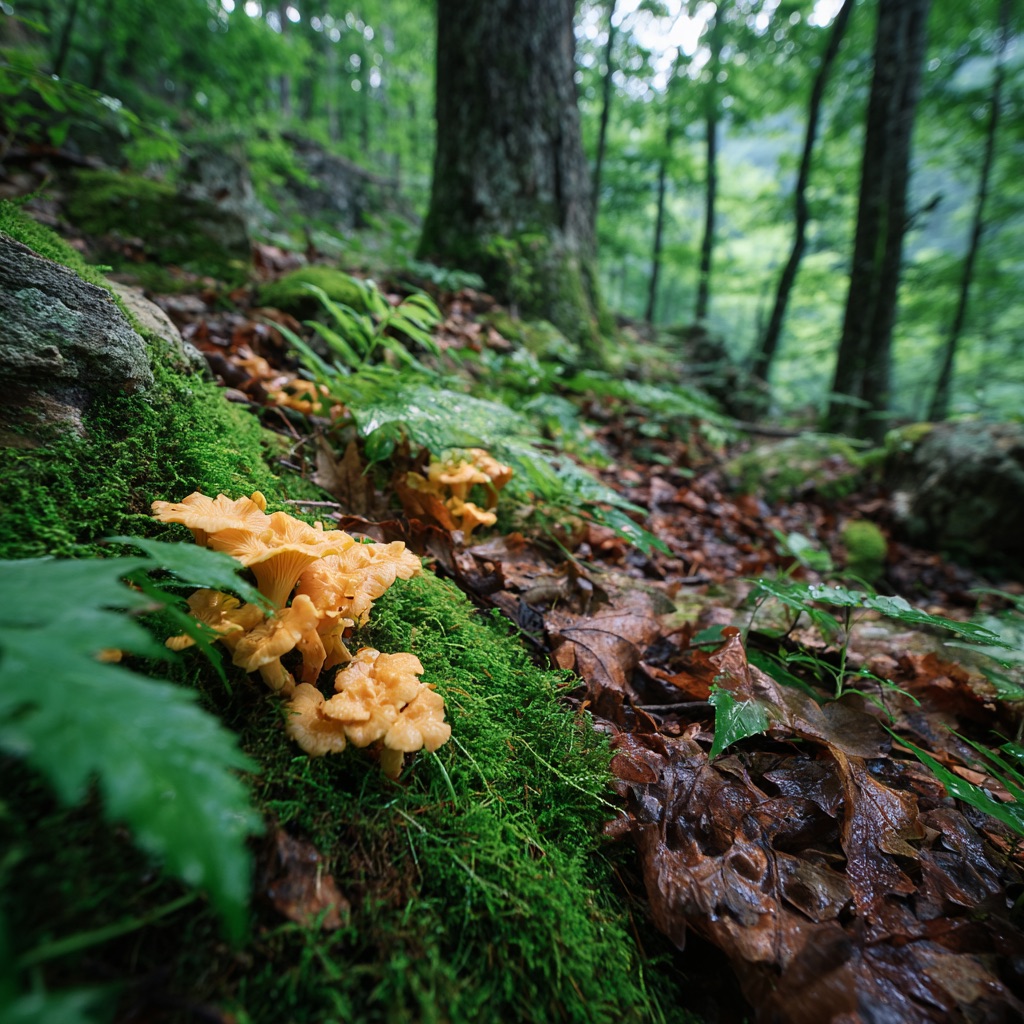
There’s a particular kind of quiet that settles into an Appalachian hollow in early spring. The hardwoods are just beginning to bud, the creek is running high with snowmelt, and the rich, loamy smell of the forest floor tells you something is happening underground before you ever see it above. That smell — earth and rain and something almost sweet — is the smell of morel season arriving.
Appalachia is one of the most underrated mushroom hunting regions in North America. The ancient, biodiverse forests of the Blue Ridge, the Smokies, the Cumberland Plateau, and the Ridge and Valley province harbor a staggering variety of wild fungi — not just morels, but chanterelles, chicken of the woods, lion’s mane, black trumpets, and hen of the woods that can tip the scales at ten pounds or more. And beyond the mountains, the broader Southeast — from the Piedmont of Georgia to the river bottoms of Tennessee and the hardwood hollows of Arkansas — extends the season and the species list in ways that surprise even experienced foragers from other regions.
Whether you’re hunting the high hollows of West Virginia, the ridgeline forests of North Carolina, or the mixed hardwoods of northern Georgia, this guide will put you on mushrooms from the first warm days of March through the last flush of autumn.
One of the great advantages of hunting this region is the extended season. The elevation gradient of the Appalachians — from valley floors at 1,000 feet to ridge tops above 5,000 — gives hunters a built-in seasonal extension that few other regions can match.
EARLY SPRING (March–April): MORELS
The Southeast sees the earliest morel season in the eastern United States. In the river bottoms and lower hollows of Tennessee, Kentucky, Virginia, and North Carolina, morels can begin appearing as early as mid-March in a warm year. The season then climbs with the elevation — as valley morels are finishing, the high hollows and ridge forests above 3,000 feet are just getting started. In a good year, an Appalachian hunter can chase morels from late March all the way into early May simply by moving upslope.
LATE SPRING–EARLY SUMMER (May–June): CHICKEN OF THE WOODS, LION’S MANE
As morel season winds down, the forests begin producing chicken of the woods (Laetiporus sulphureus and related species) on dead and dying hardwoods. Lion’s mane (Hericium erinaceus) begins appearing on wounded oaks and beeches. Both are beginner-friendly, visually unmistakable, and excellent on the table.
SUMMER (July–August): CHANTERELLES
Summer chanterelles are the Southeast’s secret weapon. While much of the country bakes in dry heat, the humid forests of Appalachia — particularly the cove hardwood forests of the southern Blue Ridge — produce golden chanterelles in remarkable quantities through July and August. This is prime chanterelle time in a region that rarely gets credit for it.
FALL (September–November): HEN OF THE WOODS, BLACK TRUMPETS, OYSTERS
Fall brings the biggest and most diverse flush of the year. Hen of the woods (Grifola frondosa) erupts at the base of oaks across the region, sometimes producing massive clusters that can feed a family for a week. Black trumpets (Craterellus cornucopioides) carpet the forest floor in mixed hardwood coves. Oyster mushrooms (Pleurotus ostreatus) fruit prolifically on dead hardwoods after the first cool rains. This is the season that turns casual foragers into committed ones.
MORELS: COVE HARDWOODS AND TULIP POPLAR HOLLOWS
The richest morel habitat in Appalachia is in the cove hardwood forests — sheltered, north-facing hollows and stream drainages where tulip poplar, basswood, white ash, and sugar maple dominate. These are the most biodiverse forest types in the eastern United States, and they reliably produce morels in the rich, moist soil around decaying hardwood root systems. Pay particular attention to areas with a mix of tulip poplar and dying elms or ashes — the combination is highly productive.
Avoid the exposed ridgeline forests of oak and hickory for morels — those are better chanterelle and hen of the woods territory. Stay in the sheltered drainages and you’ll be in the right neighborhood.
CHANTERELLES: MIXED OAK AND BEECH FORESTS
Golden chanterelles in Appalachia grow primarily in association with oaks and American beech. Look for them on sloping terrain in mature mixed hardwood forest with a deep leaf litter layer. The southern Blue Ridge — particularly in western North Carolina, northeastern Georgia, and the Tennessee border counties — is exceptional chanterelle country. Areas with sandy or well-drained loamy soils under old oaks are your best bet. Unlike in the PNW, Appalachian chanterelles often fruit in association with beech, so beech-dominated coves are worth a careful look.
HEN OF THE WOODS: OLD OAK TREES
Hen of the woods (maitake) is almost exclusively associated with oaks in this region — particularly old, large-diameter white oaks and chestnut oaks. Look at the base of living trees and recently dead stumps. They fruit in the same spots year after year with remarkable reliability; find one productive tree and mark it, because it will likely produce for decades. The drier oak ridges that aren’t ideal for morels are prime hen of the woods territory in fall.
BLACK TRUMPETS: BEECH AND OAK LEAF LITTER
Black trumpets are one of the most rewarding and frustrating finds in Appalachian foraging — rewarding because they’re delicious and there’s nothing quite like them; frustrating because their dark color makes them nearly invisible against the dark forest floor. They grow in scattered clusters in deep leaf litter under beech and oak, often on mossy slopes near streams. The trick to finding them is to get low, look for the irregular funnel shapes against the light, and once you find one, go through that area with extreme patience — there are almost certainly dozens more you’re not seeing.
CHICKEN OF THE WOODS AND OYSTERS: DEAD AND DYING HARDWOODS
Both species are relatively easy to find once you learn to scan dead and dying hardwoods. Chicken of the woods produces vivid orange-and-yellow shelf clusters on oaks, locusts, and other hardwoods — it’s visible from a distance and almost impossible to misidentify. Oyster mushrooms fruit in overlapping clusters on dead hardwood logs and snags, typically after rain in spring and fall. In Appalachia, both species can produce multiple flushes per year on the same log or tree.
MORELS (Morchella spp.)
GOLDEN CHANTERELLE (Cantharellus cibarius group)
HEN OF THE WOODS / MAITAKE (Grifola frondosa)
BLACK TRUMPET (Craterellus cornucopioides)
CHICKEN OF THE WOODS (Laetiporus sulphureus / cincinnatus)
THINK IN ELEVATION
The Appalachian elevation gradient is your most powerful tool. When the valley floors are finishing their morel season, the mid-elevation coves are peaking, and the high hollows above 4,000 feet are just getting started. The same logic applies to chanterelles in summer. Keep a mental (or literal) note of where you are in elevation and plan your season accordingly — a hunter willing to climb will consistently out-produce one who stays on flat ground.
LEARN THE COVE HARDWOOD ECOSYSTEM
Appalachian cove hardwood forests are among the most diverse temperate forest ecosystems on earth. Learning to recognize them — the sheltered, moist hollows dominated by tulip poplar, basswood, buckeye, and magnolia — is the single most useful skill a Southeast forager can develop. These forests are disproportionately productive for morels, chanterelles, lion’s mane, and black trumpets.
HUNT AFTER SUMMER THUNDERSTORMS
In the Southeast, summer thunderstorms are the trigger for chanterelle and chicken of the woods flushes. After a heavy rain breaks a dry spell in July or August, the chanterelle-producing coves can flush within 48–72 hours. Learn to watch the weather and move quickly after significant rain events.
NAVIGATE THE PUBLIC LAND PATCHWORK
Appalachia has excellent public land access through the national forests — Pisgah, Nantahala, Cherokee, Monongahela, Jefferson, Daniel Boone, and others. Personal-use mushroom harvesting is generally permitted on National Forest land, typically with quantity limits. Always verify current regulations with the specific ranger district before you go. State parks in this region are more restrictive — many prohibit foraging entirely, so check before assuming access.
MOVE QUIETLY AND LOOK LOW
Black trumpets in particular require a hunting mindset shift — you’re not looking for something obvious. You’re scanning the forest floor at low angles, looking for subtle funnel shapes in deep leaf litter. Slow down significantly when you’re in good black trumpet habitat. The same patience pays off for morels in the dense cove understory.
✅ Offline topo maps downloaded for the specific hollow or forest unit you’re entering
✅ Mesh collecting bags — bring multiple for multi-species outings
✅ Field guide specific to eastern North America (David Arora or National Audubon Society Field Guide to Mushrooms)
✅ Permethrin-treated clothing and DEET for tick and chigger prevention
✅ Snake-aware footwear — ankle-high boots minimum
✅ Plenty of water — more than you think you’ll need in summer
✅ Current regulations for the National Forest ranger district you’re entering
✅ Someone who knows your route and expected return time
Appalachia rewards the patient, the observant, and the willing-to-climb. From the first morels pushing through the tulip poplar hollows in March to the last hen of the woods anchoring an old oak in November, this region offers some of the finest wild mushroom hunting in the eastern United States. Get into the hollows. The forest has been waiting.
Explore more regional guides at huntmushrooms.com — and share your Appalachian finds with the community. Whether it’s a ten-pound hen of the woods or your first morel, tag your hauls and help build the map for hunters across the Southeast.


